
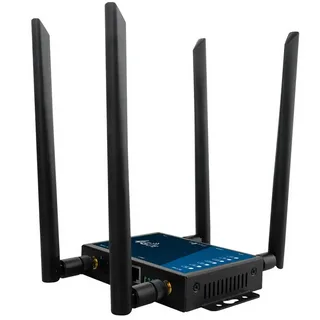
Sector Insights:
The global wireless industrial router market is witnessing for growth expansions within the industries because increasingly rely on secure with low-latency and highly reliable communication networks. In a wireless routers are critical for enabling industrial IoT (IIoT) which is supportive to real-time automation and edge computing across manufacturing, energy, transportation, oil & gas, and smart cities. According to the latest strategic industry outlook by Stalwart Research Insights they clearly mention that, the market is gained USD 1.71 bn in 2025 and is projected to exceed USD 5.55 bn by 2035 with registering a CAGR of approximately 12.5% during the forecast period so these routers are becoming central to industrial digital transformation initiatives.
Expanding its requirements for high-speed also high preferences for reliable industrial connectivity with the adoption of private 5G networks and hybrid networking solutions is driving this growth. Globally dominant Industries are prioritizing their routers that should be supportive to low-latency communication with deterministic networking and seamless integration with edge computing and cloud platforms. The increasing complexity of industrial operations especially remote monitoring requirements and the need for real-time decision-making are further propelling market adoption across various sectors.
Sector Insights: Industrial IoT and 5G Convergence Reshaping Connectivity Infrastructure
These routers are now being the backbone of modern industrial communication for connecting machines, sensors and control systems to cloud platforms and centralized management systems. The convergence of industrial IoT with private 5G networks is redefining connectivity infrastructure.
- Uninterrupted Industrial Communication: Ensures minimal downtime and seamless operations in mission-critical industrial processes.
- Deployment in Remote and Hazardous Areas: Provides connectivity where wired infrastructure is impractical, such as offshore platforms and mines.
- Expansion of Private 5G Networks: Delivers high-speed, low-latency communication tailored to industrial needs.
- Support for Automation and Control Systems: Enables deterministic latency for robotics and process management, ensuring precise control.
Product Mix Evolution: Modular Architecture vs. High-Speed 5G Routers
The market is witnessing a rapid shift toward adapt modular routers and 5G-enabled devices with modular solutions currently leading while 5G routers are driving future growth.
- Modular Routers Leading Market Share: Hold nearly 58% of the market, providing flexibility, multi-protocol support, and easy upgrades for evolving industrial networks.
- 5G Routers Driving Future Demand: Enable ultra-low latency communication, real-time automation, and edge computing for smart manufacturing and logistics applications.
Cost Pressures and Component Dependencies
During the geopolitical uncertainties especially middle east war which affecting component costs also create restrictions on global trade and supply chain delays are influencing procurement and deployment strategies for industrial routers.
- Rising Semiconductor and RF Component Costs: Affect deployment timelines and increase overall network budgets.
- Trade Restrictions Impacting Supply Chains: Regulatory limitations on telecom equipment can delay large-scale rollout plans.
- Higher Capital Expenditure Requirements: Advanced industrial routers require significant investment, influencing ROI considerations and strategic planning.
Cross-Industry Adoption Expanding Network Deployment Scope:
Wireless industrial routers are being deployed across multiple sectors to improve automation even monitoring and connectivity with each industry leveraging routers for specific operational needs.
- Manufacturing Sector: Provide supports to automation, robotics, and process monitoring for higher production efficiency.
- Energy and Utilities: Facilitates smart grid management also strongly supportive for predictive maintenance and distributed energy monitoring.
- Transportation & Logistics: Enables fleet tracking, connected infrastructure, and intelligent traffic systems.
- Oil & Gas Operations: Ensures reliable communication for remote assets, pipelines, and offshore installations.
- Smart Cities: Integrates routers into urban infrastructure for surveillance, utilities, and IoT-enabled public services.
Next-Gen Communication Technologies Driving Competitive Differentiation
In a digital tech era have vast demands for advanced routers incorporate next-generation technologies to enhance reliability with supportive to interoperability and performance across industrial networks.
- 5G RedCap Routers: It has features to provide low-power with high-reliability connectivity for IIoT devices.
- TSN-over-5G Integration: Ensures for deterministic latency within the time-sensitive applications.
- Open RAN-Based Gateways: It allow to multi-vendor interoperability and flexible deployments.
- Hybrid Connectivity Models: These is combined 5G, satellite, and LPWAN to ensure uninterrupted industrial communication across environments.
Competitive Landscape: Focus on Ruggedization, Edge Integration, and Secure Connectivity
The wireless industrial router market is moderately concentrated, with leading players continuous sifting their focus on provides ruggedized designs also which has features edge integration and secure communication.
Key industry participants include:
- Cisco Systems
- Huawei Technologies
- Juniper Networks
- Adtran Holdings
- Broadcom.
The above players are mainly working on build strong strategies to focused on enhancing innovation such as Ruggedized routers which ensure reliable operation in harsh environments and integrate edge computing for real-time processing beneficial for decision-making. They also trying to provide secure communication with robust encryption and multi-layered protocols to protect industrial data.
Future Market Direction and Strategic Outlook:
Within these market private 5G and hybrid networks will continue to drive industrial connectivity growth because it has enables for low-latency, reliable, and high-speed communication for geographically distributed operations.
- Enhanced Operational Efficiency: It reduces the downtime and enables for provide faster, data-driven decision-making.
- Scalable Deployments: Allow seamless expansion across multiple facilities with minimal latency.
In these industries clearly shows to expand demand for private 5G and hybrid networks will revolutionize industrial connectivity are enabling real-time automation. It supportive to seamless scalability which is more secure and data-driven operations are driving efficiency, innovation, and sustainable growth across global industrial sectors.